
OneWallet: Secure Crypto Transactions on OneLedger
Overview
The OneWallet is a desktop application designed to facilitate secure and efficient transactions within the OneLedger Network. As a core component of the OneLedger ecosystem, it enables users to manage digital assets across blockchain environments, particularly focusing on interoperability between Ethereum and OneLedger. The software supports the transfer of ETH from Ethereum to the OneLedger Network, streamlining cross-chain operations for users engaged in decentralized finance (DeFi) activities.
Targeted at both individual users and professionals involved in blockchain-based financial operations, OneWallet provides a user-friendly interface for managing digital assets. Its domain management feature allows users to assign human-readable domain names to their hexadecimal wallet addresses, simplifying transaction processes and enhancing usability. This functionality is especially beneficial for those frequently sending or receiving assets across multiple networks.
The developer, OneLedger, has positioned the software as a secure, decentralized solution with HD Wallet capabilities, ensuring users maintain full control over their private keys. Real-world use cases include cross-chain asset transfers, domain name registration, and token management across supported currencies. While the developer did not provide additional system requirements, the application is available for Windows, Mac, and Linux, suggesting broad platform accessibility.
Key Features & Capabilities
- Interoperability Support – Enables seamless movement of ETH from Ethereum to the OneLedger Network, allowing users to leverage OneLedger’s faster transaction speeds and lower fees.
- Domain Management – Allows users to register and manage human-readable domain names linked to their wallet addresses, replacing complex hexadecimal strings with intuitive identifiers.
- HD Wallet Functionality – Implements hierarchical deterministic wallet architecture, ensuring enhanced security and complete decentralization through private key control.
- Multi-Token Transfers – Supports the sending and receiving of any token native to the OneLedger Network, providing flexibility in asset management.
- Transaction State Tracking – Displays pending transaction states, particularly for interoperability transfers, improving user visibility into ongoing operations.
- Account History Organization – Separates ETH transactions on the OneLedger Network into a dedicated tab, improving clarity and navigation.
- Domain Mapping – Enables users to link a domain name to a website URL, enhancing the utility of digital identities.
These features collectively address common pain points in blockchain interaction, such as address complexity, cross-chain friction, and transaction transparency. For example, a user can register a domain like alice.0lt and send ETH or OLT to it, with the recipient receiving the funds without needing to memorize or copy a long address. Similarly, the ability to track pending transactions helps prevent errors in high-frequency trading or DeFi interactions.
User Interface, Workflow & Performance
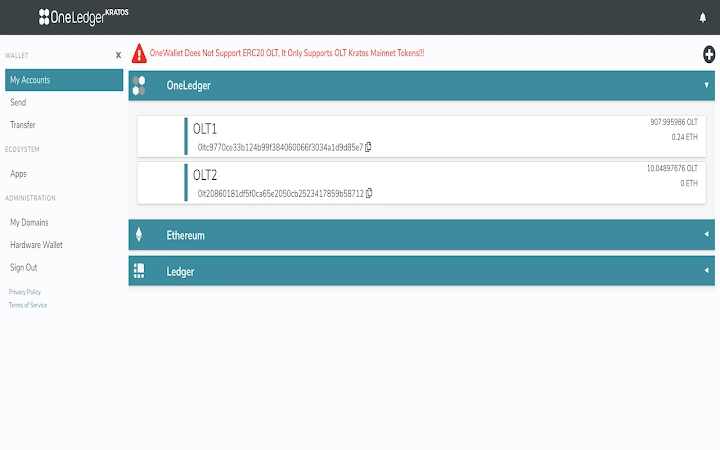
The OneWallet interface is structured to prioritize clarity and ease of navigation. Users can access core functions such as sending tokens, managing domains, and viewing transaction history through a streamlined dashboard. The redesigned search domain screen and updated icon set for different environments (Kainos vs. Chronos) improve visual distinction and reduce user confusion.
Workflow efficiency is enhanced by categorized account history and dedicated tabs for ETH transactions on the OneLedger Network. The application supports intuitive domain mapping, allowing users to associate their digital identity with a web presence. However, the developer did not specify resource usage details, and performance observations are based on general software behavior patterns.
Stability appears to be a work-in-progress, as reported issues include a persistent loading screen and display inaccuracies in transaction history. These are acknowledged as known issues, with the development team planning to resolve them in upcoming updates. Overall, the UI remains functional, though minor bugs may affect the user experience during critical operations.
Compatibility & System Requirements
OneWallet is compatible with Windows, Mac, and Linux operating systems, making it accessible to a wide range of desktop users. The software has a file size of 250 MB, indicating a moderate installation footprint. The application version is 1.2.5, released on May 15, 2024.
Exact system requirements were not listed. The developer did not provide additional information regarding CPU, RAM, or storage needs. Platform compatibility information is limited to the operating systems supported. Users should ensure their system meets general desktop application standards to avoid installation issues.
Pros and Cons
Pros
- Supports cross-chain ETH transfers between Ethereum and OneLedger Network
- Intuitive domain name system for simplified address management
- HD Wallet architecture ensures strong security and decentralization
- Clear separation of transaction types in account history
- Free to download and use with no licensing fees
- Available on multiple desktop platforms
Cons
- Known display issues with transaction history (e.g., fee shown as amount)
- Persistent loading screen reported in some instances
- Limited system requirement details provided
- Requires users to distinguish between Kainos Mainnet and Chronos Testnet versions
- Domain mapping feature is functional but lacks advanced customization options
FAQ Section
Is OneWallet compatible with Windows, Mac, and Linux?
Yes, OneWallet is available for Windows, Mac, and Linux operating systems, offering broad desktop platform support.
Is OneWallet free to use?
Yes, the software is provided at no cost. There are no licensing fees or subscription requirements.
Can I use OneWallet offline?
While the application can be launched offline, full functionality—such as transaction broadcasting and blockchain synchronization—requires an active internet connection.
How often are updates released?
Updates are released periodically, with the latest version (1.2.5) published on May 15, 2024. The developer has committed to fixing known issues in future releases.
What is the difference between Kainos Mainnet and Chronos Testnet versions?
Kainos Mainnet is the production environment for real transactions, while Chronos Testnet is used for testing. Users must ensure they are using the correct version to avoid unintended actions on live networks.
Final Thoughts + CTA
OneWallet stands out as a secure, cross-chain-ready desktop wallet tailored for users navigating the OneLedger Network. Its domain management system and interoperability features offer tangible benefits for those managing digital assets across multiple blockchains. While minor display and loading issues persist, the core functionality remains robust and well-structured.
Designed for both casual users and professionals in DeFi, the software delivers a balance of security, usability, and flexibility. The free model and multi-platform availability further enhance its appeal. With ongoing development and planned fixes, OneWallet is positioned as a reliable tool for modern blockchain interaction.
Download OneWallet now